Forestry Services

Tree Injury By-law

The new Tree Injury By-law 4075-2026 protects and enhances the County's forest, soil, water, fish, and wildlife resources and supports responsible woodland management and Good Forestry Practices. It replaces the former “Forestry By-law” (also referred to as the “Forest Conservation By-Law”).

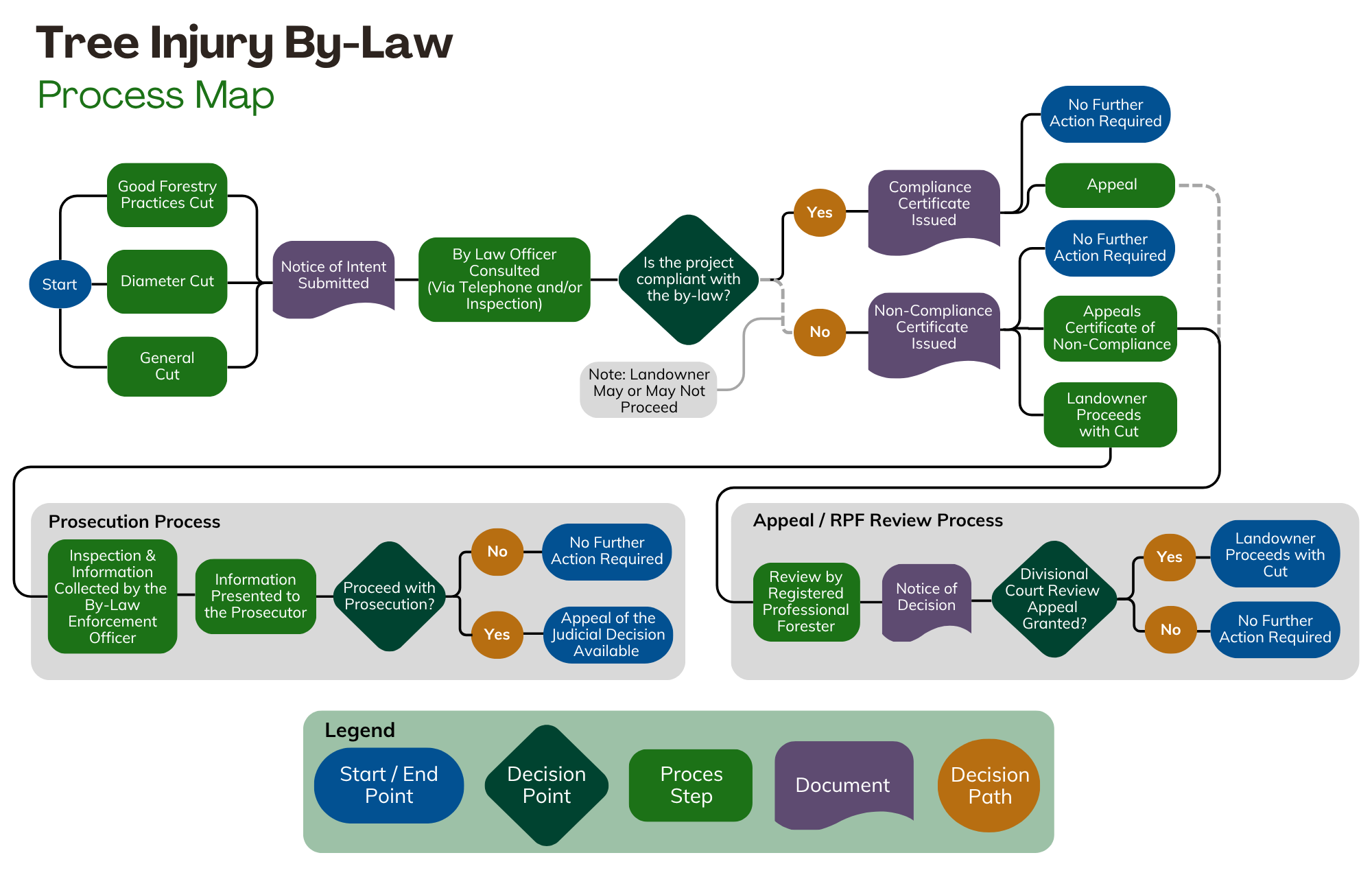
The new By-law modernizes woodland regulations, provides greater clarity for landowners, fosters communication, and establishes a new review and appeal process. 
Key updates included in the new By-law:

  • New Purpose section outlining the By-law’s role in supporting woodland preservation, promoting cooperation between property owners and the County, as well as achieving the objectives of Perth County’s Official Plan.
  • New definitions for windbreaks and tree plantations to provide greater certainty regarding which treed areas are regulated under the by-law and which are exempt.
  • Clearer woodland boundary identification, with the ecological boundary of a woodland continuing to define the regulated area. Where appropriate, the tillage mark adjacent to agricultural fields may be used to help identify the woodland edge.
  • Additional agricultural exemptions, including:
    • selective trimming of branches along field edges to accommodate farm equipment;
    • repositioning of dead trees that have encroached into cultivated areas or access routes; and
    • removal of trees forming part of a windbreak, tree plantation, or nursery stock operation.
  • New Compliance Certificate process requiring all Notices of Intent to receive either a Compliance Certificate or a Non-Compliance Certificate, providing landowners with a clear written determination regarding proposed tree-related activities.
  • New independent appeal process that allows landowners and affected parties to appeal decisions related to Compliance and Non-Compliance Certificates.
  • Appointment of an independent Appeal Officer, who will have the authority to request additional information, conduct site inspections, consult with relevant agencies, and issue final decisions on Certificate appeals.
  • Recognition of invasive species management, allowing the removal of specified invasive tree species without requiring a Compliance Certificate.

The updates are intended to improve clarity, consistency, and transparency while balancing environmental stewardship, sustainable forest management, and the needs of rural landowners and agricultural operations.

If you have questions about the new By-law or you are planning upcoming tree-related project on your property, please contact us.

On March 21, 2024 Perth County Council passed the following resolution requesting that By-law #3836-2021, commonly referred to as the "Forestry Bylaw", be reviewed. A thorough review process was undertaken including a jurisdictional review and public consultation process.

On June 18, 2026, County Council approved a new Tree Injury By Law (By-Law No. 4075-2026). This By-Law replaced the previous Forest Conservation By- Law (By Law No. 3836-2021).

Additional Information: 

Noxious weeds and invasive pests

Perth County’s forests are susceptible to threats from noxious weeds and invasive pests. Protect the resources you have in your woodlot by being informed about forest health threats. Visit the information below to learn more about noxious weeds and invasive pests that are currently present in the County of Perth, or have the potential to invade our area.

Don’t Move Firewood Campaign (Canadian Food Inspection Agency)

In an effort to proactively prevent the movement of invasive species and diseases, the federal government has an awareness campaign titled “Don’t Move Firewood”.

Many local campers or cottage-goers travel a great distance to get to their destination. Invasive insects and tree diseases can live and travel in your firewood products. Moving untreated firewood (even a few kilometers) is a common way for invasive insects and diseases to spread.

Some of the pests/diseases that can spread quickly via firewood movement include; emerald ash borer, hemlock woolly adelgid, dutch elm disease, spongy moth, brown spruce longhorn beetle, spotted lanternfly, and oak wilt. Don’t forget that these pests can also “hitch a ride” on your vehicles, tools, boots, and other outdoor gear or equipment.

Moving firewood from places where regulated pests have been found is a violation of the Plant Protection Act, with penalties of up to $50,000 and/or prosecution. Be aware of movement restrictions that may be in place before you move wood or wood products.

If you see any invasive pests or have questions about moving firewood, contact the Canadian Food Inspection Agency.

Noxious weeds

Ontario Ministry of Agriculture, Food and Rural Affairs has created a list of all noxious weeds within Ontario as per the Weed Control Act, R.SO. 1990In addition to this list, the County has also identified the following as noxious weeds:

Life Cycle: Annual, reproducing only by seed.

Habitat: Velvetleaf occurs in southern Ontario where it is increasing in corn, soybeans and other annually tilled crops and in waste places.

Description: It is distinguished by its erect habit of growth, large, alternate, valentine-shaped leaves which are very soft-velvety to the touch, its yellow to yellow-orange flowers, each with a central column of stamens, its ring of several seedpods produced from each flower, and in late autumn bloom the rather grotesque to blackish stem with many erect clusters of seedpods.

Life Cycle: Perennial, reproducing only by seed.

Habitat: Purple loosestrife was introduced from Europe but is now widely naturalized in wet meadows, river flood-plains, and damp roadsides throughout most of Ontario.

Description: Its opposite leaves and square stems resemble plants of the Mint Family but it is distinguished by having separate petals, a seedpod with many fine seeds, and it lacks the minty odour.

Invasive pests

The Ontario Ministry of Natural Resources and Forestry has provided educational information on common invasive pests:

Susceptible Trees: oak, birch and aspen, sugar maple, American beech, eastern white pine and Colorado blue spruce (Picea pungens) in Southern Ontario.

Characteristics and Life Cycle: Over the winters the egg stage occurs on the bark of trees. During spring, eggs hatch and larvae ascend the trees to feed on the new growth. As young caterpillars they feed generally during the day but throughout development will transition to nighttime feeding. Feeding damage ranges from small “shotgun” holes in leaves to consuming entire leaves. As caterpillars they measure approximately 50mm long, dark in colour, hairy and have a double row of five pairs of blue spots, followed by a double row of six pairs of red spots proceeding down their back. Male moths are light brown and slender-bodied, while females are white and heavy-bodied.

Symptoms and Damage: Spongy moth outbreaks occur every 7 to 10 years.  Larvae chew holes in leaves or devour entire leaves.  In late July, spongy egg masses can be observed on the trunks and branches of infected trees.  During severe outbreaks, trees and shrubs are completely defoliated over large areas; despite the trees’ ability to produce a new crop of leaves over the summer, the damage causes significant growth loss.  Understory shrubs and plants may also be affected.

Susceptible Trees: all ash species in Ontario, including green, red, white, black and blue ash, as well as some non-native species such as European black ash.

Characteristics and Life Cycle: Metallic green adults emerge in June and July and are generally between 8.5-13.5 mm long. Adults have a flattened head, large black eyes on the sides of their heads and short antennae. The eggs are laid within the bark of ash trees and there can be as many as 90 eggs. Larvae feed by chewing “S” shaped tunnels under the bark and can be identified by their cream-colour, flattened body with a brown head and pincers. Larvae pupate in April or May and adults can be seen around two weeks later. The entire lifespan can be completed within one year.

Symptoms and Damage: Meandering “S” shaped tunnels (galleries) wrap around the ash trees and foliage will wilt or turn yellow. Emerging adult beetles leave a “D” shaped exit hole that is 4 to 5 mm across on the bark of infected trees. Frass (refuse left behind by boring insects) or sawdust will be evident in tunnels. Because the tunnels made by larvae girdle the tree, it cuts off the flow of food and water. This causes branch mortality which leads to eventual tree death. Epicormic shoots (growing from a previously dormant bud) may appear on the tree’s branches and trunk.